|
By Steven Marrocco
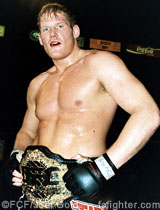
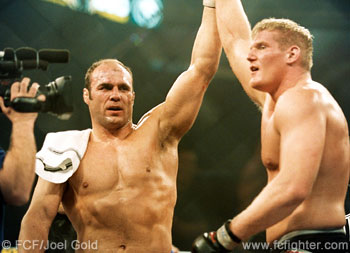
It was a long layoff for "The Babyfaced Assassin." Caught in the wake of Pride Fighting Championship's sale to Ultimate Fighting Championship owners Zuffa, LLC, Barnett spent most of 2007 waiting for the phone to ring. 2006 was the busiest of his professional life, one that put him on top ten lists of heavyweights around the world. But his relationship to Zuffa had been acrimonious to say the least, and with Zuffa's new status as the sole major MMA organization in the market, Barnett had few to no options. Things started to look up for Barnett in October of 2007 when World Victory Road was formed in Tokyo. The company was a consortium of figures from the Japanese pro wrestling, in addition to the Japanese real estate industry. WVR had links with J-Roc, a talent agency in Japan, which paved the way for the signing of much-loved judoka Hidehiko Yoshida. Barnett was contacted shortly afterwards to participate in WVR's inaugural show, as he puts it, to continue an old rivalry between catch wrestling and judo. FCF caught up with Barnett to get his thoughts on his layoff and the fight. Here are some excerpts: FCF: Was it a relief for you when they called? JB: It will be a relief when the fight's over. FCF: Why is that? JB: I don't count on anything until it's been seen through. I've learned that through plenty of years in this business. Lots of people like to say a lot of things, but are they really willing to come through on their end? Most of the time, people are just running their mouth. When fighting "blew up," a lot of newcomers tried to jump into the market. They thought they knew what the reality of things where. And they come to me, trying to tell me they know how much people make, based on released figures from the state of Nevada or word of mouth, internet, who knows. And I flat out tell them, 'you don't know what you're talking about.' If you're interested in working with me, you're going to have to understand that you don't understand, so come back when you have a better idea, and when you're really willing to go to that next level. FCF: Was this whole experience frustrating for you? JB: Absolutely. Incredibly frustrating. Especially because of most of the time, the way it went down, I believe Pride sold all its fighters out. They knew they were intending to sell for quite some time, and decided to get long contracts on some of the fighters to try and use them to sweeten an acquisition deal. But without telling us, of course. Then we turn to the politics of the UFC, they're in the market of....you know, I hate to equate it to the Communists, or the other practices like that, but control the propaganda to have it lead exactly how they want it to. They write the history so it's only theirs. FCF: Well, as a fighter who's been around for a long time, you have a different viewpoint. It's not as black and white as the Zuffa version, you're aware of a lot of the gray areas. JB: I remember when there weren't events to fight in. They talk about people from the TUF generation, and they really try to portray them as the second generation of "Ultimate Fighters" or martial artists. But in my mind, they're so way down the list. They haven't been around at all. They're not second generation, they're like fifth perhaps. Guys like myself, Babalu, even Tito, we're second generation, we were the next guys to come in there after the initial startup of mixed martial arts. FCF: Do you have any resentment of those fans? JB: No. They only know what they're fed. You can't ask a guy to understand what ice cream tastes like if he only drank coffee his whole life. FCF: With all of these business struggles, has it been hard to keep fighting and training fun for you? JB: Fighting and training is great. But the difficult part is tending to my own career. For me, that's just hair-pullingly frustrating. I have to sit back and watch one guy, who in my opinion is not likely to fight much longer, even if he does get the one big fight he wants, yet I already went through him. So why is it that I have to be treated as second tier to that guy? But I've stood by my track record to be an exciting fighter, to bring entertainment wherever I go. Any given scenario, I know I can add some interest. I can be the good guy, and I can be the bad guy. I've proven it plenty in Japan. I think I did okay here in the UFC, but both times, I fought in some dark spots for the company. By the time I beat Randy, it was still really fringe. I still think it's really fringe. I kind of missed the gravy train on both ends. FCF: You've always been an iconoclast, an individual. Do you think that had anything to do with the way things turned out or some of the frustrations that have come up as of late? JB: I can't necessarily put all of it on the UFC. They don't pull all the strings in the world. They've got some great opportunities and they've made the most of it. And within that opportunity they've decided how they were going to use it. I guess that's where people like myself have issue with it. I guess I can go with being an iconoclast. I've always the type of person to go my own way, to try to have as much in charge of my destiny as possible. I've always preferred to work alongside people instead of for them. Promoters aren't always going to do even the best thing that's in the best interest of both sides. When money gets involved, people change, they do shady things. People's minds get a little warped sometimes. If you've got that talent under a really restrictive leash, kick and cry as they might, they're stuck in that situation without means to improve upon it for their own sake until the contract expires. But if that short leash isn't there, the promoter does something shady, then the talent's going to say 'Hey, forget you. I don't have to stand for this.' And they don't like that aspect either. FCF: You mentioned Randy Couture. Did you view his resignation as a positive or negative? JB: It's good to see him stand up for what he feels is fair compensation. I've heard all the stuff that I'm sure influenced his choice to make his decision to do what he did. I think it's some pretty BS kind of stuff as well. But I think at this point whether it turns out to be positive or negative, we'll have to see how it turns out in the long run. It's also going to depend on the choices that he makes now that he decided to go this route. Of course, publicly, the perception on whether what he's doing is it for self grandeur and wealth or is it for principles. That remains to be seen. And at the core of it, is it going to make changes to help everybody? I don't know. This thing isn't over yet, as far as whatever it is that he's trying to accomplish, so I don't think he's getting this Fedor fight any time soon, and even if he does have it, it isn't going to give him what he wants, unless he just wants a really big paycheck, and I think in that he'll be successful.
FCF: Let's talk about fighting now. How do you feel about Yoshida? JB: He's a good friend of mine. He's a great training partner in Japan, but right now, he's standing in front of me, and he's another notch on my belt in my whole storyline of judo vs. catch wrestling revived. FCF: Describe your history with him. JB: Well, when I was over in Japan training Bob Sapp, and doing wrestling for New Japan Pro Wrestling, I used Tsuyoshi Kosaka's gym on a regular basis. It was called G-Square. Kosaka helped train and is a good friend of Yoshida's as well, and Yoshida and Nakamura all used to train at that gym, so we all trained together for quite some time. After that, we'd always see each other at Pride, Nakamura and I have a common sponsor, so we'd see each other all the time. We made a constant gesture to exchange t-shirts and saying hi to each other backstage all the time. Now, it's just business. There's a lot of people in the fight game. But that doesn't mean that you can't fight them, or that you won't have to fight them. FCF: You frame this as catch wrestling vs. judo, but you're not considering your strikes? JB: I can guarantee that he's going to taste some leather. Hopefully his fillings are in pretty tight. But there's a whole history between catch wrestling and judo. One of the most famous ones would be this catch wrestler, Ad Santel, who challenged the Kodokan and all the judoka at the time, and defeated a large majority of them. Ad Santel would go on to train Lou Thesz, one of the most famous American pro wrestlers at the time as well. Interestingly enough, on the same day me and Yoshida are fighting, Ad Santel had a match in Tokyo at Yasukuni shrine against a judoka named Reijiro Nagata. The Kodokan forbid their judo practitioners from going out and competing in these matches, but two of them did anyways. And Nagata was the first one that Santel wrestled, and Santel defeated him by TKO from a slam on the same day, March 5th. FCF: Has the Japanese picked up on this story line? JB: Some of them have. Some of them are very familiar with the story, even though it happened 87 years ago. The very next day or very soon thereafter, Santel had his second match, they wrestled to a draw, and because of that interaction between catch wrestling and judo, the judoka would later go on to train in wrestling, and to bring amateur wrestling to Japan. FCF: So you believe you fit into this whole struggle and would like to beat him with your catch wrestling? JB: Obviously. I fought Nakamura before, which revived this thing. Then I took on Pawel Nastula, who's by far one of the best judokas of this decade, I defeated him as well. So now you have Yoshida coming to take revenge for his student and defend judo at the same time. I don't know if he's falling into the story line all that much, that's ok. But I think it creates more interest than just some random fight. FCF: Will Yoshida have the gi for this fight? JB: I'm not sure. I would bet money on people wanting him to wear the gi. Personally, I want him to wear the gi, it's just more interesting that way. It is a disadvantage in quite a few ways, especially if you know how to manipulate the gi. But at the same time, it also gives you quite a few advantages. FCF: He's had a lot of time learning how to utilize that gi and you haven't had as much time, so that doesn't concern you? JB: No, I've got an inkling to try and choke him out with his own gi. |
| © All materials contained in the Full Contact Fighter web site are protected by copyright and to be used only for personal and noncommercial uses. Public display or copying for sale or public distribution of any of these materials is strictly prohibited. |